Crawley Boys
Growing up in Crawley
The memories of three old towners
|
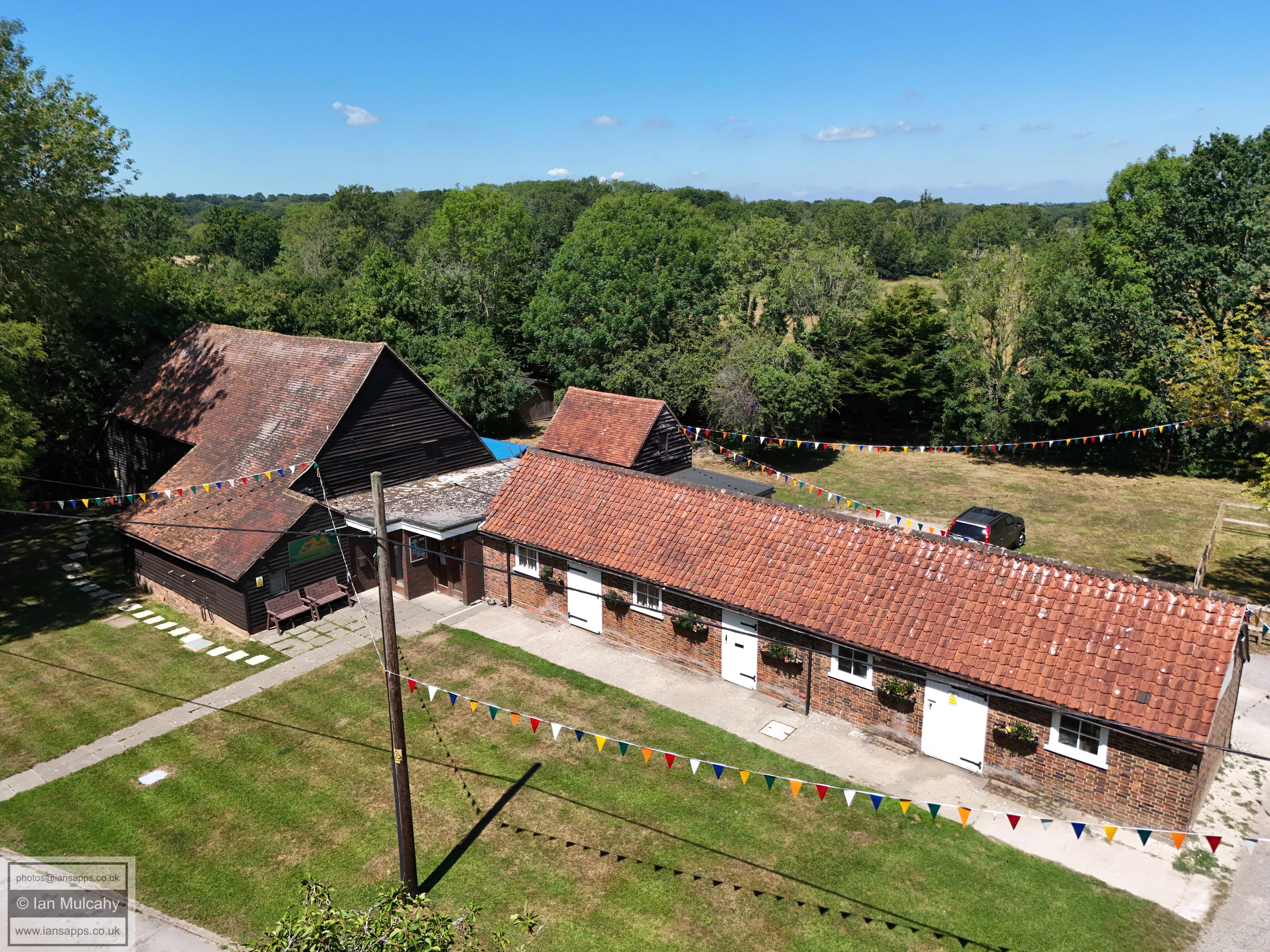
The accounts below are based on the memories of Eric Jenner, Andrew Lock and Stewart Lock as told to Ian Mulcahy during an informal recorded chat over the course of almost 2 hours at Ifield Barn Theatre on 14 September 2025, with researched historical context added to complete the stories. All three were born in Crawley before the new town.
All images are clickable for a full size version.
Firstly, a very brief history of Crawley for the benefit of those unfamiliar with the back story to the new town. Crawley (Crow Lea - a clearing with crows) is a settlement dating back to at least late Saxon times which was granted a market charter by King John in 1202. By the time the Second World War broke out in 1939, Crawley was a small country town which was home to around 7,500 people and characterised by a High Street rich in Medieval and Tudor era buildings. Ifield & Three Bridges were still separate settlements.
During the Blitz, many areas of London were destroyed which left hundreds of thousands of Londoners living in cramped, sub-standard accommodation and resulted in the passing of The New Towns Act of 1946. The purpose of the act was to facilitate the building of planned satellite towns in the countryside around London, and on 9 January 1947 Crawley, encompassing Ifield & Three Bridges, was designated as a New Town. Work commenced in West Green in 1949, with Smalls Mead having the distinction of being the first new town road to be constructed. West Green was followed, in chronological order of commencement, by the neighbourhoods of Northgate, Three Bridges, Langley Green, Pound Hill, Ifield, Southgate, Tilgate, Gossops Green, Furnace Green, Broadfield, Bewbush, Maidenbower and Forge Wood.
By 1951 the population of Crawley had seen a slight increase to just over 10,000, but by 1961 this had jumped to over 67,000. Today over 120,000 people call Crawley home.
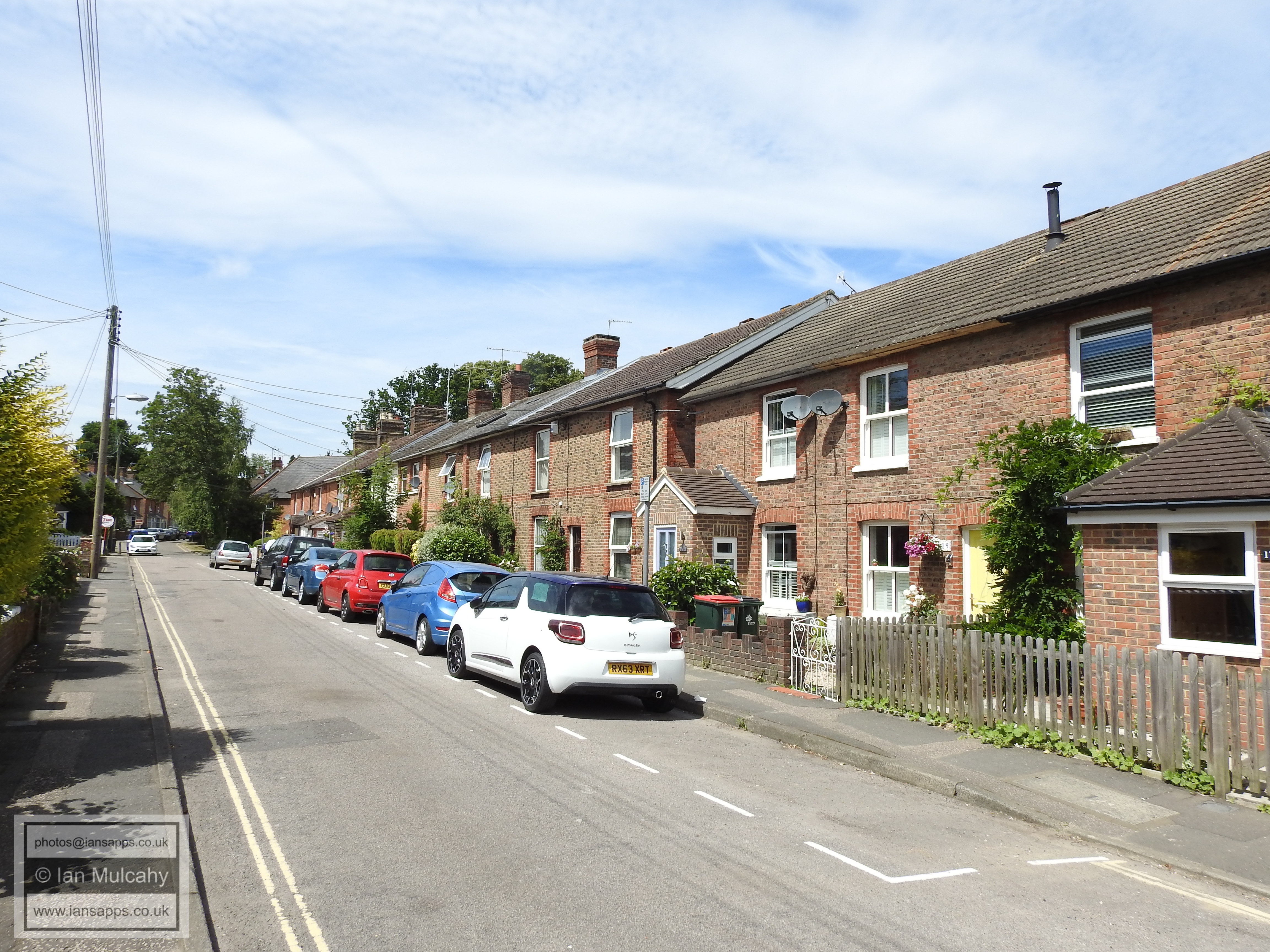
Eric Jenner was born at home in Prospect Place in West Green in 1939 and remained there until he married, later living in Furnace Green. He describes Prospect place as a ‘scrubby little area’ that was just a dirt track with a terrace of four Victorian houses at the end. These houses still stand today. Eric attended the British School in Robinson Road before moving on to Horsham Technical School for his secondary education. The conclusion of Eric’s education in 1954 coincided with APV moving from Wandsworth to Crawley and he successfully applied for an engineering apprenticeship with the Company, staying with them until 1988 when they relocated and closed the Crawley site. He subsequently secured employment with Upjohn, who were also based in Manor Royal.
Andrew Lock was also born at home at 50 West Street in Southgate in February 1940, and moved with his parents and siblings to a brand new ‘Corporation house’ in Shipley Road, Ifield in 1958. Like Eric, Andrew attended the British School before moving on to Horsham Technical School and, whilst knowing OF each other, they didn’t really know each other due to being a year apart. On leaving school Andrew embarked upon an engineering apprenticeship with Bell Precision who, at the time, were based in the Victoria Hall at the northern end of the High Street. The Hall was built in 1920 to host concerts and other social functions before being converted to an industrial premises by the late 1940s.
Stewart Lock was born at home too, also at 50 West Street, in 1948, so has no memories of Crawley as it was pre new town, but instead grew up and went to school with many of the children of the new towners. He moved to Shipley Road with Andrew in 1958. By the time Stewart had attained school age, the new town schools were opening and the British School had closed its doors to infants and juniors, so he attended the brand new West Green Primary School (a school described by Eric as a ‘beautiful and well-built’ facility), later moving up to the new Sarah Robinson County Secondary School in Ifield. Being a student at new town schools gave him ample opportunity to meet and make friends with the new town children.
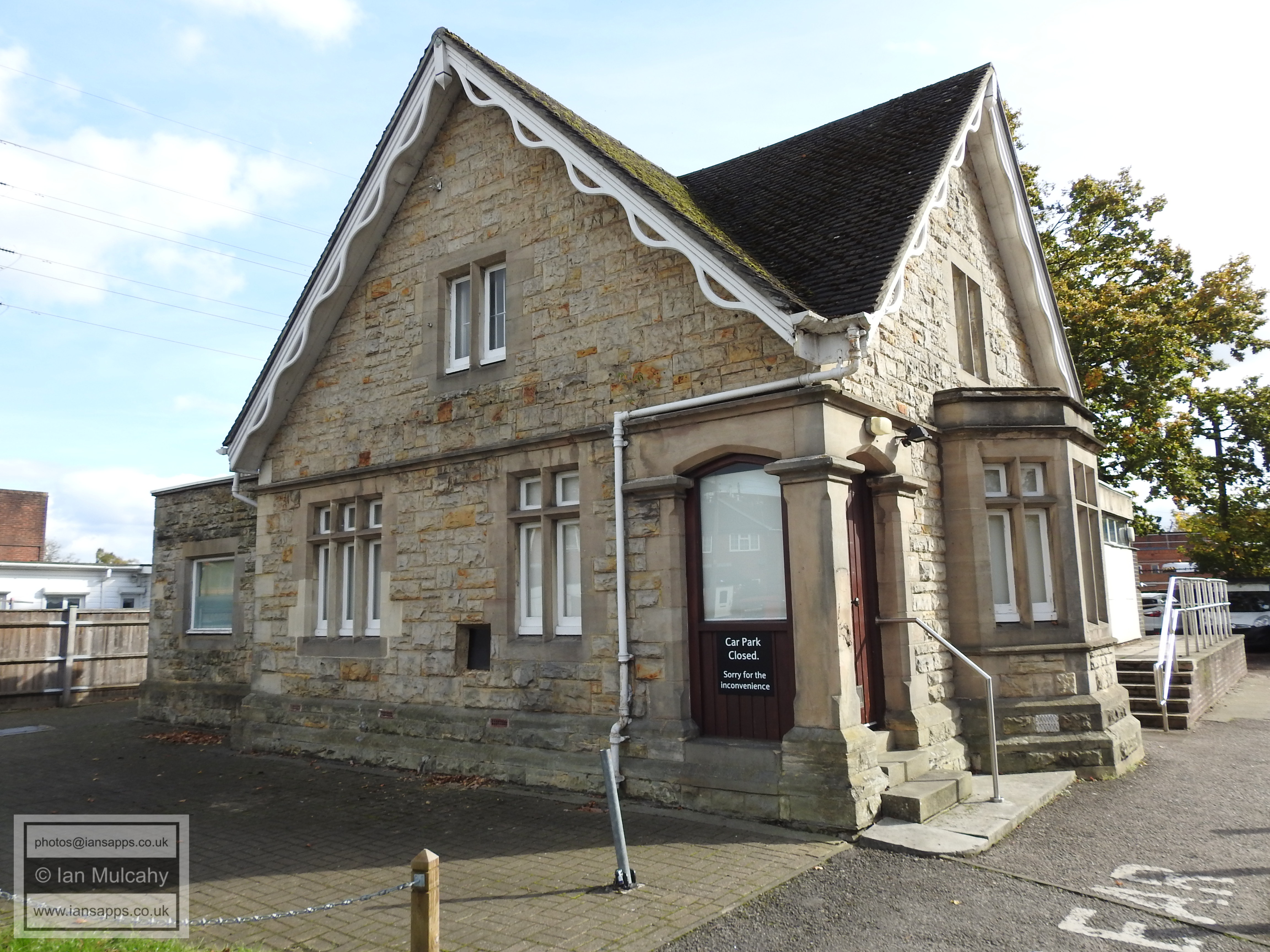
Crawley was just a small country town prior to 1949 and with Eric living on the north of the railway and the Locks on the south of the railway, their paths would have rarely met, despite living less than 500 metres apart as the Crawley crow flies. As Andrew explains, if you didn’t have a reason to go somewhere then you probably wouldn’t, and he had no reason to go to Prospect Place, a cul-de-sac off Alpha Road behind The Swan. Similarly, Eric had no reason to go to West Street which was a residential road forming, along with Oak Road, a crescent off Springfield Road that leads nowhere other than back to Springfield Road. Andrew adds that the only reason they left Crawley as a young child was to visit his aunt in Three Bridges, and they would walk there, usually along Three Bridges Road, but sometimes they would cut through The Hawth, coming out of Tilgate Drive onto Three Bridges High Street by the lodge to Tilgate Mansion.
Eric concurs, adding that nobody ever went to Ifield, Lowfield Heath or Three Bridges unless they had specific reason to; people generally stayed within Crawley because they had everything they needed there. Eric would go to Ifield and Lowfield Heath a lot because he had relatives in both villages, but that was the only reason. People from the villages surrounding the town did, however, come into Crawley and Eric’s mum told him that after Sunday School she would, as a child, climb onto a flat horse drawn wagon which would take her and her friends into Crawley. Erics mum found this trip to be a great thrill.
Of course, everyone would have visited the shopping areas in the High Street and most of the children would have gone to school in either Robinson Road or Victoria Road but, as well as being in different year groups whilst in school, at the end of the day Eric would have turned right out of the school gates and walked home via Spencers Road whereas Andrew would have turned left to get home via the High Street and Springfield Road meaning they had few opportunities to associate. Andrew had no relations in West Green so he’d rarely cross the railway, apart from for shopping or school.
Another occasion that a resident from the south would have crossed the tracks would be at the onset of child birth! As we’ve already seen, all three of our reminiscers were born at home, and that was quite usual in those days; you would only be born in hospital if there were problems, like an awkward or breech birth, explains Andrew. Few people had a telephone at home in those days, the Locks included, so when an expectant mother went into labour in Crawley during the 1940s, the father-to-be would make himself useful and hurry to Ifield Road where Nurse Preston lived, near the junction with Goffs Lane, and ask that she come and deliver the baby. When Andrew was born, in February 1940, we were in the middle of a lousy winter with lots of snow and ice on the ground; a treacherous journey for both Nurse Preston and Mr Lock!
On the subject of telephones in private homes, Andrew recalls seeing a sign outside a house in Crawley Down announcing that ‘we have a phone here’; a community minded notice that essentially advised that anyone could come in and use it in the event of an emergency, though I’m sure there was a small element of showing off involved too. Unfortunately for Mr Lock Senior, there were no such signs on display in West Street at the time of Andrews birth.
The War in Crawley. Despite being a small town in the country, Crawley was not the safe place that you might expect it to have been during the war. The town was on some of the German flightpaths to and from London, and Gatwick Airport, which was requisitioned by the RAF when war broke out, was also nearby. Several bombs fell on the town during the course of the conflict, and no incident was more serious than that which occurred on the afternoon of 10 July 1944 when a doodlebug landed on Cooks Yard in Oak Road, near to the junction with West Street, killing 7, injuring 44 and destroying both the builder’s yard and 15 houses. 4 year old Andrew was inside 50 West Street, less than 100 metres away from the blast, playing on the stairs with a friend when the doodlebug exploded. He doesn’t remember a bang, but does recall the plaster falling from the ceiling onto them and his mother who, once she had checked that the boys were ok, dashed out of the house in search of his friend’s mother, who she met rushing down the street, to reassure her that all was well with the boys.
5 year old Eric was in his living room in Prospect Place, some 350 metres away, and recalls his Lockd front door flying open and a chair moving from the centre of the room into the doorway, as though someone had been sitting there. As well as the door being blasted open, the ceiling in the back bedroom of Erics home came down but, unsurprisingly, Andrew’s house suffered far more damage, with the windows blown in and most of the plaster being detached from the walls and the ceiling. Fortunately, it was only surface damage and the house was structurally sound, though uninhabitable, so the family decamped to Andrews aunt’s house in New Street, Three Bridges for several months. Andrew can’t recall how long they were away from West Street, but he does recall still being there for Christmas (of 1944). Andrew’s mother had told him that the Salvation Army were at Oak Road serving tea to survivors before the dust had settled, and she always had a soft spot for them as a result.
Eric recalls how the large plate glass window of Holmans the Grocers, on the parade of shops to the east of The Crown, was blown out by the force of the blast. He also remembers hearing about the doodlebug which landed on Ifield Green, (on a currently unknown date, but around the same period) which severely damaged the village school on the bend in Rusper Road, as well as some nearby cottages, but fortunately caused no injuries.
Andrew tells of an occasion when he was in the back garden of 50 West Street with his mother and next-door neighbour watching a Doodlebug flying over with the engine still going and the adults saying “oh good, it’s gone by”, relieved that it wasn’t going to fall on them. Eric remembers living similar experiences, standing outside watching several pass over without threatening his safety, but one day he was watching one when the engine cut out shortly after it had passed overhead and he says that you’d never seen everyone run so much in all your life, diving to find cover. This must have been the one that fell on Ifield Green.
Many doodlebugs landed, exploded and caused carnage of course, but the nation wasn’t completely defenceless against their threat. As well as shooting them down where it was safe to do so, the RAF would often track them, positioning a wing under the flying bomb and, once the engine cut out, guiding them into open countryside away from populated areas. Eric remembers how the local gossip at the time was that a Hurricane had got the V1, but lost control of it and that is what caused it to fall on Oak Road. The pilot, distraught at what had happened, landed at Gatwick, stole a car and rushed to the site to see the damage before killing himself. He doesn’t know how true this was, but it is what everyone was saying at the time.
The account of the V1 incident being the result of an error whilst it was being ‘flipped’ has been independently repeated by Wayne Covey, the great grandson of Will Dench, whose mother told him a similar tale. Dench was working at Cooks Yard at the time of the explosion, but thankfully survived after being treated in Horsham Hospital. Wayne was also told that the pilot visited the site soon after, but his final act wasn’t mentioned.
At the time of the war, Willoughby Farm was leased by Erics uncle and in his big field a series of telegraph poles were sunk to stop enemy planes from landing, a precaution also recalled by Rex Williams in his book ‘You Must Remember’. One day a plane did crash at Willoughby Farm and Erics uncle rushed out with his shotgun as the pilot climbed from the cockpit of his undamaged Auster exclaiming “it’s OK, I’m British”, to which Erics uncle retorted “I don’t care what you are, I’ve got the gun and it’s on you until the police come”. Rex Williams recalls hearing the plane’s engine cut out and watching it glide down from his home in Ifield Road and, as he was prone to doing, dashed out to chase it. When he arrived at the farm, the pilot was sat having a cup of tea with Erics aunt, presumably with his uncle’s shotgun still trained on him!
As D-Day approached, Crawley bypass was closed to civilian traffic as the tanks heading to the coast gathered there, and hard standing was built alongside to host the military workshops. Much of the hard standing survived throughout my own childhood in the 70s and 80s when it was used as a depot by WSCC Highways Department to store their aggregates. Today, the area is occupied by the hotel and petrol station near Gossops Green. The Royal Engineers also had a large base to the west of the London Road, where B&Q and Matalan can be found today.
A final war memory is shared by Andrew, who remembers iron railings being removed from around the town for melting down.
School for children in Crawley, before the new town was built, was either at the Crawley & Ifield Church of England School on the eastern corner of Ifield Road and Victoria Road or the Crawley & Ifield British School in Robinson Road.
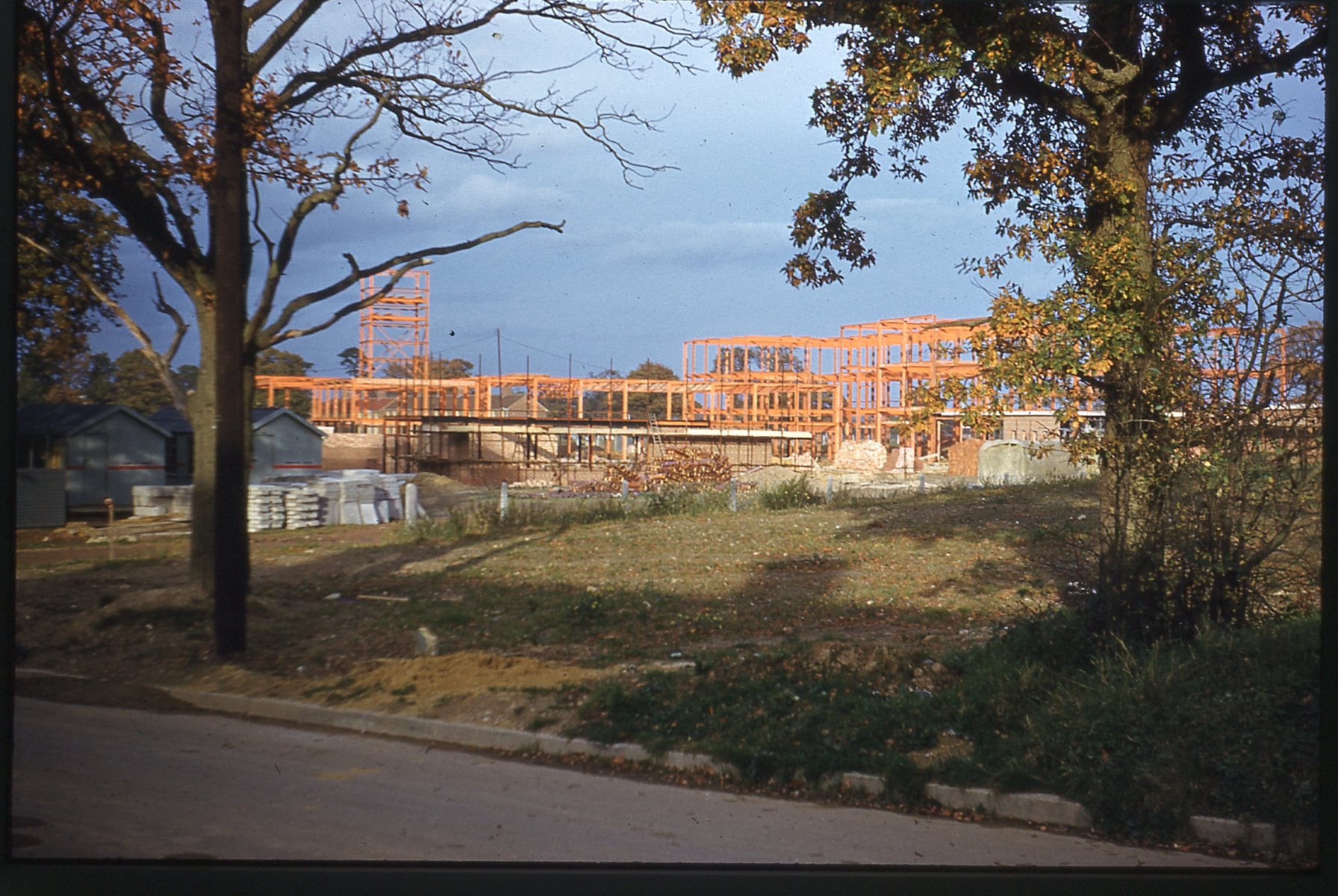
The Church of England school was originally founded in 1831 by Sarah Robinson as the Crawley & Ifield Charity School but, by 1851, the church had assumed control and only children whose parents attended the Anglican Church were permitted to receive an education in Crawley. Disagreeing with this policy, Mrs Robinson once again embarked on a fundraising drive and by 1854 the British School had opened on a site in what was then known as New Road. The Church school was rebuilt in 1878, at which time it was known as the National School, and Sarah Robinsons British School was rebuilt in 1916. The Church of England School, as it was then known, was bombed during an air raid on 4 February 1943 leaving the infants school destroyed and the juniors badly damaged. Thankfully the raid occurred before the start of the school day, but the school was closed for weeks and shut its doors for good on 24 Feb 1955, with pupils transferring to the newly built St Margaret’s School in Ifield. The British School, in what by then was known as Robinson Road, transferred infants and juniors to the brand new West Green County Junior and Infants' school in 1953 with some of the older students transferring to Hazelwick. The final few pupils left the school for the new Sarah Robinson County Secondary School in Ifield in 1956.
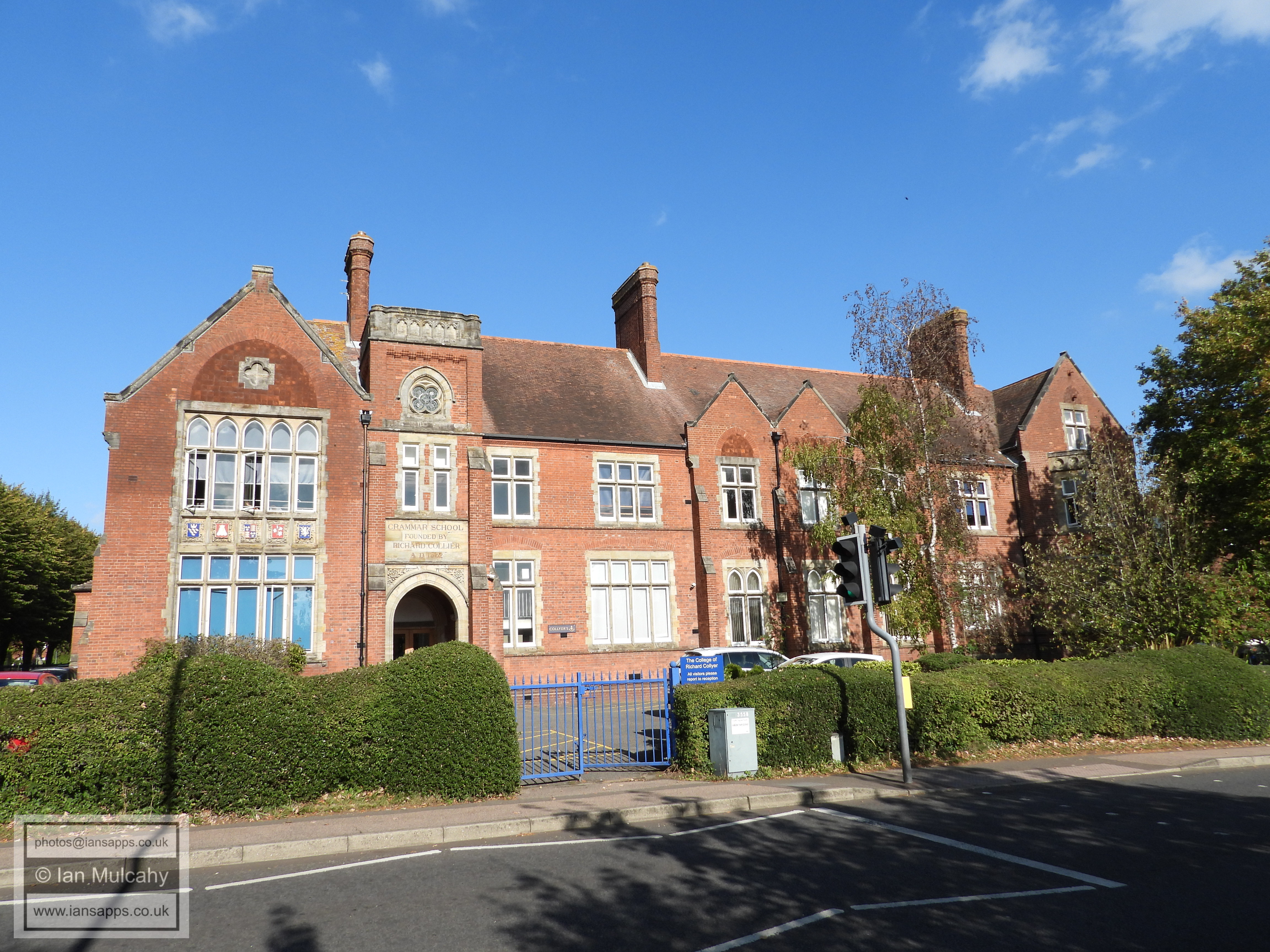
Before the new local secondary schools were built, options for children resident in the parishes of Ifield & Crawley were either Collyers, for those who passed the 11+, or Horsham Technical School for everyone else, both of which were in Horsham. Collyers, founded in 1532, has been on its current site in Hurst Road since 1892 and Horsham Technical School was based in what would later become the Forest Hospital in Crawley Road, though its entrance was at the northern end of Comptons Lane. Originally built as the Horsham Parish workhouse in 1838, the building served as a hospital for Canadian casualties of World War 2. After the war, part of the building became a hospital for adults with learning difficulties while the rest, including the military huts, became the school, which later moved to the southern end of Comptons Lane and became Forest Boys School.
Those who lived over the parish boundary in Worth, which was anyone who lived west of where the Broadway now stands (the boundary also marked the division of East & West Sussex), were sent off to East Grinstead, such as Eric’s good friend Jack Taylor who he never saw again after they left the British School. Once the new town construction was underway and Crawley Urban District Council was formed in 1956, there were significant boundary changes which meant that the town ceased to be split into two for 11 year olds!
As we’ve already noted in the introductions, Eric and Andrew attended the British School in Robinson Road and Stewart the brand new County School at West Green. For secondary school, Stewart barely had to step out of his new home in Shipley Road before he arrived at the new Sarah Robinson County Secondary School in Ifield, but there was no such luxury for Eric or Andrew who had to race to the original Crawley Station each morning to make sure they didn’t miss their train to Littlehaven; the nearest station to Horsham Technical School.
Leisure time for youngsters in 1940s and 1950s Crawley meant being out and about with friends. The bomb site in Oak Road was a favourite for Andrew and Stewart, but mostly after the rubble had been cleared and the area had become overgrown wasteland. Eric used to play on a communal plot of grass in Prospect Place at the front of his house with his neighbours Billy Bassey, who was a year younger than him, and Sheila Knight who was a year older. Sometimes he would venture across the railway to Goffs Park, but at that time, with the exception of the lower area alongside the tracks, most of the area was private land and if you “got on to it and were mucking about” the dogs would soon be released and “you’d never moved so fast in all your bloody life”!
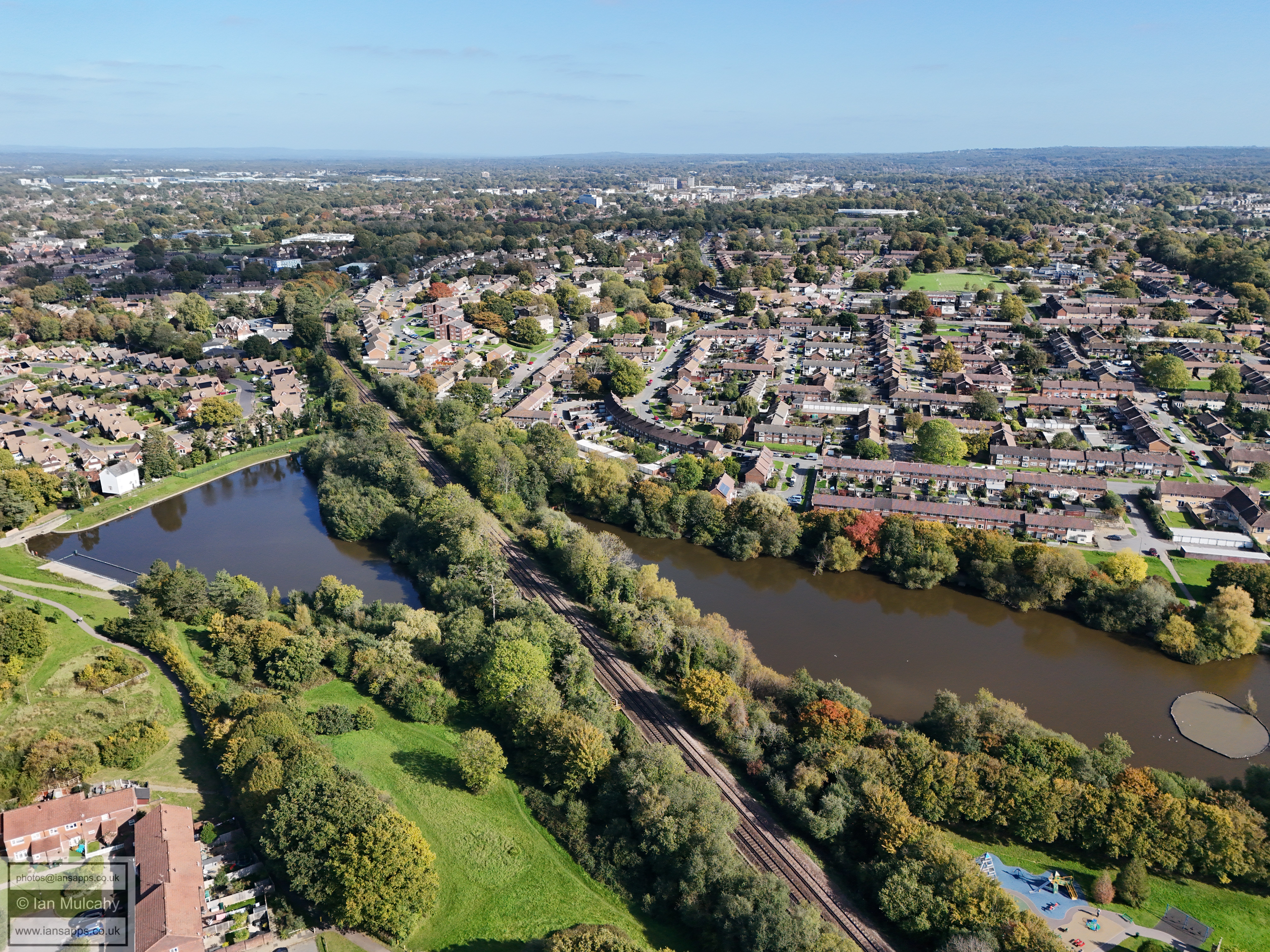
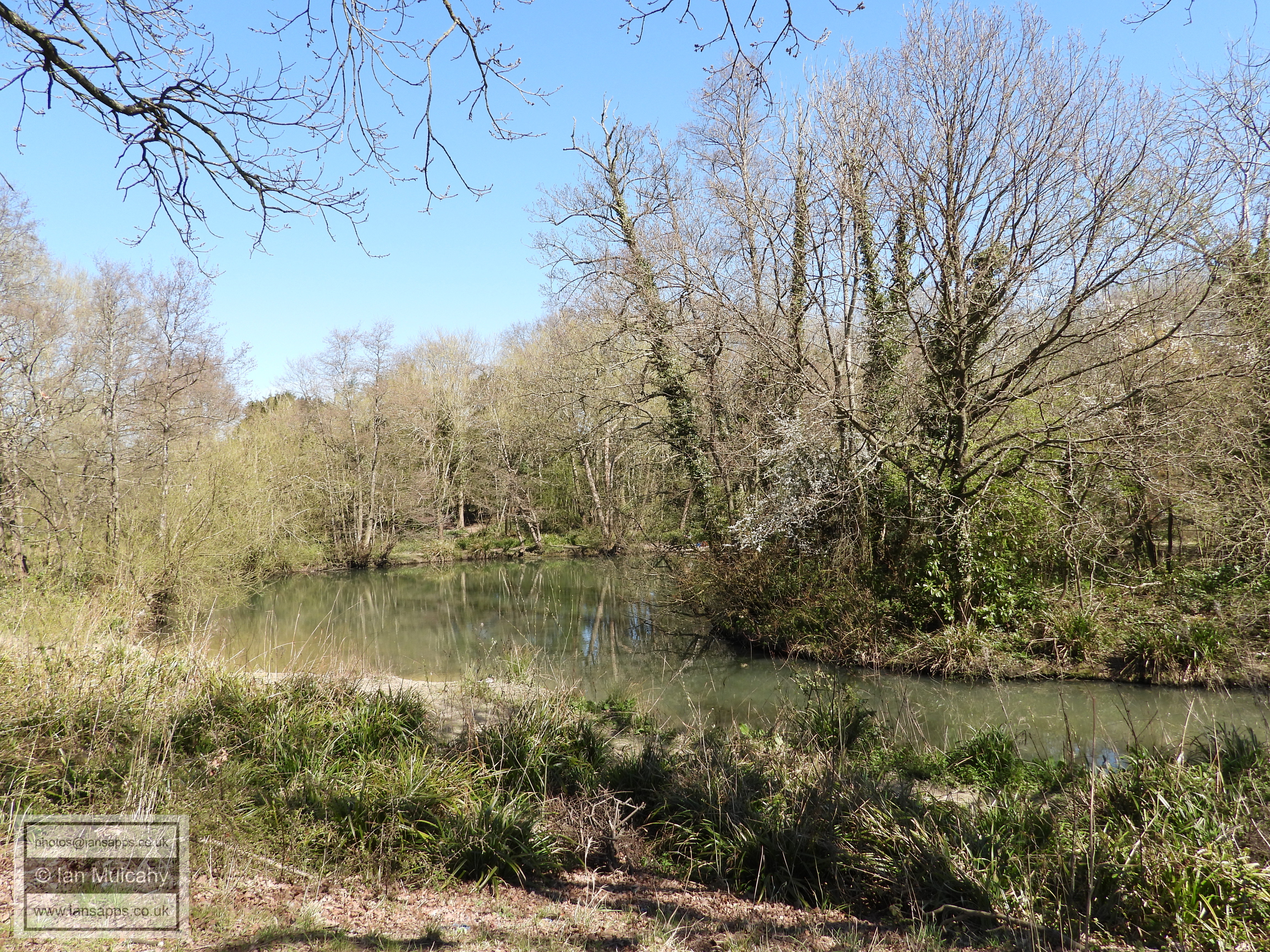
Andrew and his friends roamed a bit further afield for play and exploration, taking themselves up to the Millpond at Ifield via Goffs Park and Gossops Green Lane where they would play around both the northern and southern pond, crossing the railway where they pleased. Back in the 1940s and 1950s there was no need to find a bridge or crossing point as the tracks were unguarded, giving people the autonomy to cross at a convenient point. It amazes Andrew that there’s a need to fence off the tracks these days, as does the fuss that’s made if a fence is broken, because when he was young, everyone had the common sense to know that before crossing they needed to watch for trains and when they were crossing, that they shouldn’t step on the electric rail.
At other times, they would play in the area around the pond at Broadfield Wetlands, opposite Little Buckswood Farm (now Cheals/Squires Garden Centre) where Stewart remembers the dam at the downstream end and the foundations of the old boathouse, though the structure itself was gone by this time. Other times they’d walk through the woods towards where the football stadium now stands, picking wild daffodils. The Hawth was also another favourite place for Andrew to play.
Stewart, being born in 1948, didn’t have quite the scale of open countryside to play in as his older brother, but would still go around Broadfield & Bewbush picking wild daffodils, but as more and more of the area was developed, the available playing areas gradually shrunk. However, with few motor cars on the roads, the street was always a playground for everyone.
Getting out and about for Eric involved more formal activities, and he used to go to Town Mead (Crawley’s old ground in West Green which was where the Leisure Park now stands) to watch Crawley, where he stood behind the goal which would later become the Shed End, but at the time was just flat. He particularly remembers watching Doug Bastable (236 appearances between 1939 and 1955), Phil Bastable (119 appearances between 1939 and 1953), Peter Bastable (6 appearances between 1946 and 1949) and goalkeeper Freddie Towl (39 appearances between 1949 and 1952). Towl was also a teacher at the British School. The players used to change behind Northgate Laundry, near the Almshouses in Northgate Road, before the changing rooms were built at Town Mead, and they would walk across the northern end of the High Street to access the pitch. These facilities were presumably also used when the team played at Yetmans Field, just south of The Driftway. The centre spot of this pitch was roughly at the junction of the Link and Buckmans Road.
On one occasion he was watching his dad play football when the ball came over and hit the pram containing his little sister, almost tipping it over. That was the last time Eric’s mum ever went to watch football!
After a brief career as a football supporter Eric took up refereeing, starting out in the Crawley League, but later progressing to the linesman’s list for the Southern League, where he ran the line for 6 years whilst occasionally refereeing friendlies for Three Bridges. Whilst there were adult sports teams in the town, there was precious little organised sport available for children growing up in Crawley during Eric’s childhood, outside of school, but in later years both of Erics sons played for Southgate West Spartans Football team, with Eric often taking up the whistle at their matches.
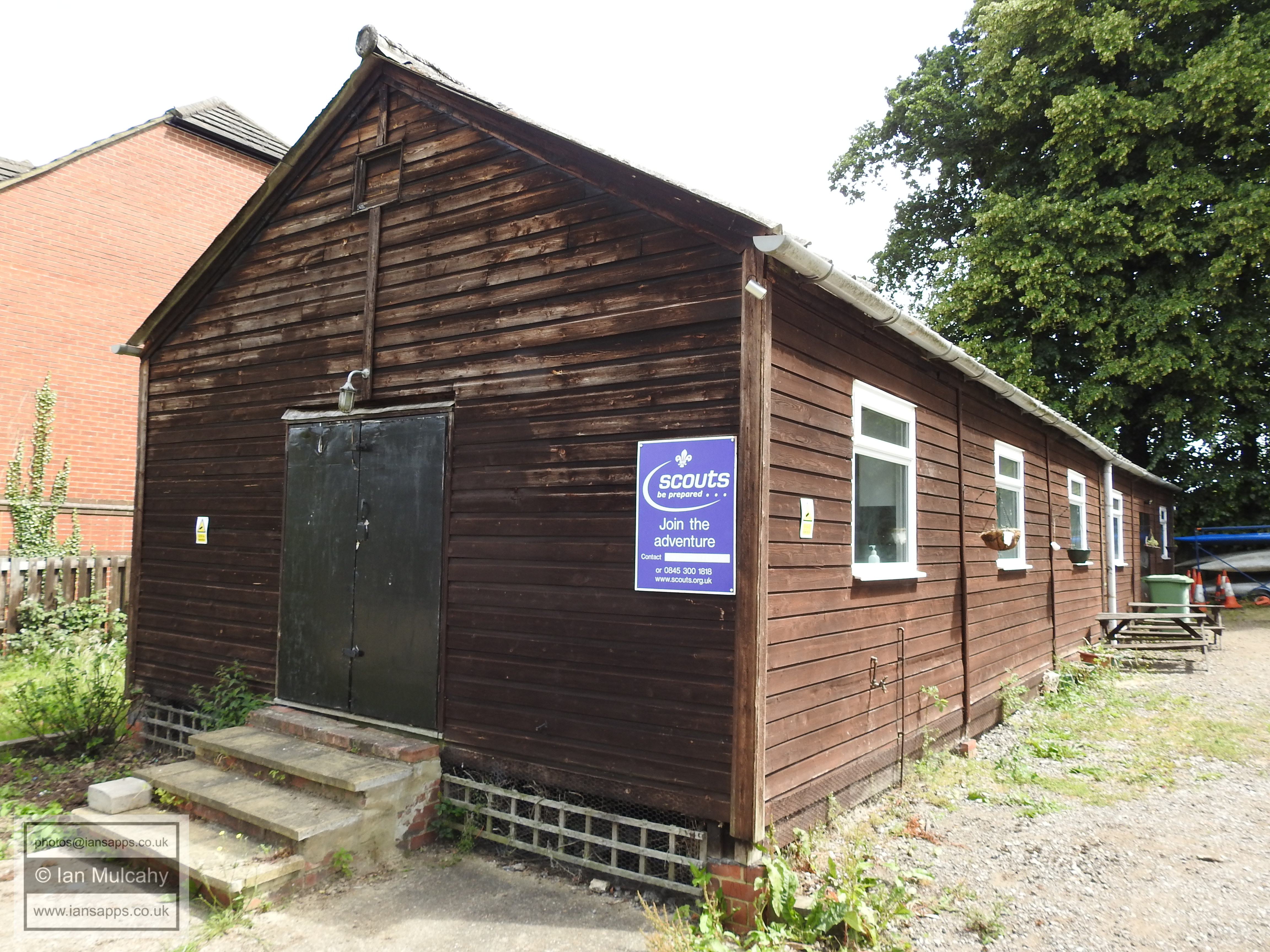
One activity that was available was the Scout movement. Eric joined the Cubs and was a member of the 1st Crawley troop who were based in Victoria Road next to the Church of England School in a hut bought by Ernie Stanford CBE. Stanford was a founding member of Crawley Labour Party who later chaired Crawley Parish Council and acted as vice-chair of the Crawley Development Corporation. Eric recalls obtaining his ‘Leaping Wolf’ badge shortly after the end of the war and, along with the badge, was given a little strip of paper with his name and the date written on to affix to the Totem Pole. When Eric went to add his strip, the only one already there was that of David Lock, an older brother of Andrew and Stewart! Eric later moved up to the Scouts and after a year or two he was due to participate in a show of some description, but when he was told it would involve him wearing a tutu skirt and clodhopper boots, he told them to ‘get stuffed’ and that was the end of Erics time in the Scouts… for the time being.
At 17 he decided he wanted to be involved again, so went back to Victoria Road to help out with the Cubs and ended up staying for 21 years, his wife later becoming a cub leader too. As mentioned previously, the 1st Crawley Scout headquarters was damaged in the 1943 bombing and the troop had precious few funds with which to make repairs. Around the same time, 3rd Crawley Scouts were meeting in St Peters Church Hall at the Alpha Road end of Prospect Place, but the hall was due to be demolished. They had secured a plot of land in Oak Road, cleared for them courtesy of the German Doodlebug but, they too, were short of funds and didn’t have the money to do anything with the land and were on the verge of folding when it was suggested that 1st and 3rd Crawley merge and pool resources. The new troop, adopting the name of 1st Crawley, secured an unwanted hut from the army barracks near Aldershot and brought it back to Crawley in pieces where it was reassembled in Oak Road and remains to this day.
Andrew also attended 1st Crawley Cubs, but didn’t stay for very long at Scouts. His brother David, whose slip of paper Eric had come across on the Totem Pole, attended the Cubs during the war at which time it was hard to come by the fabric used to make the normal green jumpers, so he wore a grey jumper throughout his time there.
Eric’s grandmother lived in Lowfield Heath, still a small village with a little airfield nearby, so he was a regular visitor during the war, travelling there on the 405 Crawley to Croydon bus with his mum and often staying overnight. Eric’s mum was born and grew up in Lowfield Heath so she and his father were married at St Michael and All Angels Church in the village and Eric was baptised there, as was his sister. Eric also remembers the original Gatwick Airport station near the Greyhound which opened as Tinsley Green Station in 1935 and was renamed Gatwick Airport Station a year later when the new Beehive airport terminal opened. The station closed in 1958 when the new airport terminal was completed and Gatwick Racecourse station reopened as Gatwick Airport Station.
During the war Gatwick was home to night fighters which Eric didn’t see, but the airstrip was also used as a crash station; a place where damaged planes returning from missions could land when, in all likelihood, they wouldn’t make it back to their usual base. After the war, Eric was taken to an air show at Gatwick by an uncle, fresh out of the army, where two displays in particular stuck in his mind. The first involved a man driving out onto the airfield in a Volkswagen and parking it inside the framework of an aeroplane whereupon it was bolted to this framework and then driven at speed until it took off! The second was a setup whereby a rope was strung between two high poles with a line coming down holding a loop onto which a man, presumably from the RAF, was clipped. A plane then flew low across the airfield, dropped a hook which caught the loop and carried the man off into the air. Andrew explains that this was the method by which people were retrieved before the days of helicopters, and recalls seeing footage of such a manoeuvre.
This event would most likely have been the second Daily Express Air Display which was held in 1948 and drew a crowd of 70,000 people to Gatwick.
Lowfield Heath was, of course, mid-way between London & Brighton and once the war had finished it became a popular stop off point for a procession of cars and charabancs heading to the coast in the morning and back to London in the evening. Outside of the White Lion was a large area of waste ground, and this is where the charabancs would pull in. The passengers would disembark and go to either the pub, café or shop. They might even buy some flowers from the numerous sellers operating here, particularly the men on the way home if they’d perhaps ‘overdone it’ a bit during their day out to the seaside! As the passengers did what they needed to do, the charabancs would gradually move forward in queue, a bit like a modern taxi rank, with the expectation being that all of the passengers would be back on board by the time it reached the front.
The White Lion was one of four local stopping points, the others being the Thorns (later the Game Bird and later still The Air Balloon) at Horley, the Black Horse at Hookwood and the Black Swan at Pease Pottage. Eric also remembers seeing the charabancs making unscheduled stops on the hard standing areas at Gossops Green where the military workshops once stood to give the passengers the opportunity to go to the luggage hold and retrieve some fresh bottles of beer that were stored there in crates. I expect some ‘recycled’ beer was also deposited in the nearest hedgerow during these stops.
Not so much a leisure activity, but Eric also spent time travelling around the area when, at the age of 14, he got a job with Wales the butchers in the High Street as a driver’s mate to the owner’s son, helping with the Saturday meat deliveries. The morning would take him around all the new town neighbourhoods of the time; West Green, Langley Green, Northgate & Three Bridges, and then in the afternoon they would drive out to Lowfield Heath and Ifield Wood & Village. He was also charged with collecting orders from the customers for the next delivery on Wednesday, but of course he didn’t help with that as he was at school.
Shopping in old Crawley was generally confined to the High Street and the eastern end of Ifield Road where mostly independent shops provided everything that was required by the people of Crawley. Andrew remembers many of the old shops along the eastern side of the High Street including The Cabin outside the old Crawley Station, Withers Records (7), The Post Office (11 &13), Kales the barbers and tobacconist (15), WH Smiths (19) and the Co-op (21, 23 & 25), which Eric remembers as being the main place to shop.
On the western side, Andrew and Eric between them recall Hibbs the bakers (2), a blacksmiths in Hammer Yard (which was probably so named because of the nature of the business residing there), Fogdens (18), which was a men’s clothes shop, Mence Smiths (22 & 24), Warrens Hardware (30 & 32), Bastables Fish Shop (34) with their fish and chip shop in the alley behind, another Co-op (38, 40 & 42) which was more of a men’s outfitters than a grocers, Yetmans (36), Barclays Bank (50 & 52) and Woolworths (6 Grand Parade), in the unit now occupied by Weatherspoons.
Back on the eastern side, a Blacksmiths operated down a little lane behind the old houses between the Brewery Shades and the White Hart. Morley’s Forge and Yard was replaced by the open space to the south of the Brewery Shades at the end of The Broadway when the new town was developed. Andrew also recalls the lodge to The Rectory, which was where the junction of The Boulevard & High Street is now, and the famous old Crawley Elm outside of what is now Crawley Museum. Further north was the Bus Garage and behind that, in Northgate Road, were the almshouses where a relative of Eric’s lived.
As well as Bastable’s fish mongers and fish and chip shop in the High Street, where Phillip & Peter worked with their father, there was another fish mongers in Ifield Road operated by Doug Bastable, Phillip & Peter’s brother. Eric recalls that if you went to Doug’s shop in Ifield Road then you never went to the one in the High Street.
In the Co-op there was a payment system in operation whereby you did your shopping and handed payment to the assistant who placed it into a little metal container with a note of what you had bought. The container was sealed and the assistant pulled a lever which sent the can flying across the shop on a wire to a central office in the middle, where the payment was removed and replaced by a receipt and any change that was due before it was sent flying back to the counter to be handed to the customer. As a child this fascinated Eric who thought it was great fun watching the cans flying about at busy times.
For haircuts, Eric used to go to Wellers Sweet Shop and Barbers on the Ifield Road Parade next to The Crown, whereas Andrew used to entrust his locks to ‘Old Tom Savage’ at 1 Ifield Road, on the southern corner of the High Street. This barber shop later became Flemington’s.
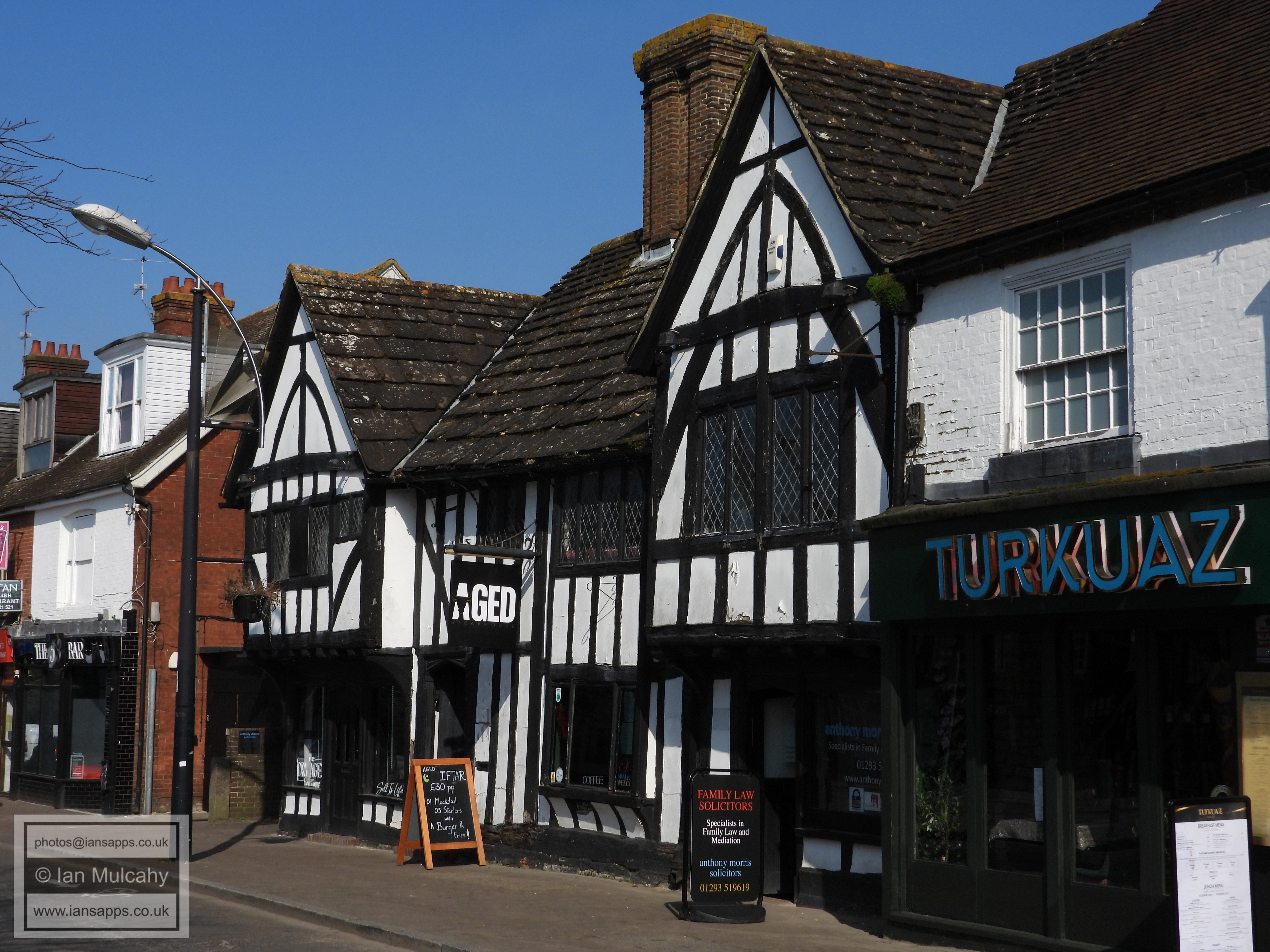
A bit later on, in the early 60s, Eric’s wife was a physiotherapist and one of her clients was the lady who ran the restaurant based at the Ancient Priors. This was a high class restaurant at the time and, as a thank you, Mrs Jenner was given complimentary meal for two. After eating their meal, and drinking wine for the first time ever, they were invited upstairs by the proprietor for a coffee and Eric was fascinated by all the ancient beams and the layout of the building.
Going back to the period after the Great War, when Andrew and Stewarts mum was a child, an annual cattle market was held in the High Street, but unfortunately Mrs Lock, as she was to become, was scared of cows so for the period while the market was being held, she used to run from the level crossing to school in Robinson Road so as to pass them as quickly possible. It’s interesting to note that she also grew up in West Street, showing how families didn’t go far in the old days. Andrew & Stewarts Aunt Lil also lived in West Street, presumably in the same house that their mum grew up in, and remained there after her sister’s family had moved to Ifield.
James Longley & Sons were a respected local building Company who were founded in the 1880s and were based in East Park, next to the railway line. The Company boasted an impressive portfolio of completed works, including Christs Hospital and many railway Stations. The respective fathers of Eric, Andrew & Stewart both worked for Longley’s, who won contracts for a lot of the new town building work including Hazelwick School, Crawley College, most of West Green and much of the industrial estate. When the Queen came to the town in 1958, most of the buildings that she visited were built by the Company. Andrew, Stewart and Eric all remember Longley’s, and Sir Norman Longley in particular, as being ‘bloody good employers’ who cared for their workforce. Andrew recounts how, when his father died suddenly, his mum got a letter from Sir Norman saying that he assumed she was ok because her sons would be looking after her, but to let him know if she needed anything. For years afterwards, at Christmas time, one of the younger members of the Longley clan would personally visit to deliver a little bonus, and he would always insist on coming in, rather than standing on the doorstep, so he could look around and make sure the family were doing OK and not living on the breadline.
Eric’s father first joined Longley’s as a labourer at the age of 14 when the death of his father meant he needed to work to look after the family. He returned to the Company after the war, working his way up the career ladder to the position of site agent, so Eric didn’t see much of him as Longley’s had contracts all over the place meaning he was often working away from Monday morning until Friday evening. When working on a project a fair way from Crawley, Longley’s workers would live on site in a large hut and this hut would be the first thing erected on a new site. Longley’s would provide transport to these sites and there was one occasion when Eric’s mother was in hospital. On the first day of the job the site gaffer approached Eric’s father and said “I hear your wife is in hospital”, which Erics father confirmed, and he said “so you’ll be wanting to get home a bit early in order to go and visit her will you”, which Eric’s father agreed would be nice. Later in the day the foreman said “I’ve got to finish work an hour early and take you home so you can go to the hospital”, but both were still paid in full. They had been on site for the whole day as far as Longley’s were concerned. At the end of the week Eric’s father asked the foreman how much he owed him for petrol, but that had all been taken care of by Longley’s too.
As the new town started to be developed there were both positives and negatives for those who were already residents of Crawley, and it seems as though the positives were mainly enjoyed by the younger generations, whereas the older generations felt the negatives more. As we’ve already discussed, the first new town houses were built in Smalls Mead, West Green - a stone’s throw from Eric’s house, and it seems some people took that phrase a little too literally as Eric recounts how some locals, who hated the idea of the new town, would throw bricks through the windows of the new builds after night had fallen, though he personally denies everything!
The most important positive for the younger generation was the huge increase in employment opportunities that the new town brought. Before the war there was little diversity of occupation in the town and most Crawley, Three Bridges & Ifield men would either work as farm or estate labourers, on the railways, or for Longley’s. As well as bringing people from London, the new town plan also brought industry and employment to Manor Royal, the new industrial estate to the north of the town, which rapidly expanded as numerous companies relocated. This enabled Crawley to boast the lowest un-employment rate in the country for many years and, even during later periods of economic uncertainty, the new town legacy (which includes the decision made in 1950 to designate Gatwick as London’s second airport) always ensured that there was work available locally.
Eric wanted to be an engineer, and the new town enabled him to achieve that ambition when he secured an apprenticeship at APV in 1954 on leaving school. Had Crawley not been selected as a new town, his engineering opportunities would have been considerably reduced, with his potential employers being limited to Bowthorpes, Lintotts in Horsham or Bell Precision at the northern end of the High Street, where Andrew was apprenticed. Andrew & Stewarts mother was always anti new town, but they would argue the point that were it not for the huge change being experienced by the area then their employment opportunities would have been considerably less abundant.
The younger long time inhabitants still had cause to feel some level of resentment though as, on applying for housing, they were put on the Council list and could wait for anything up to 15 years to be housed whereas the newcomers from London were added to the Corporation list and were housed in three to five years. As Andrew points out though, the houses WERE being built specifically to accommodate Londoners, but it must have still been a bitter pill to swallow to watch your countryside being destroyed whilst being excluded from personally benefiting from the sacrifice. Andrew also says that if you married a new town girl, i.e. the daughter of a Corporation tenant, then as a couple you would benefit from her priority and join the Corporation’s list and, whilst he says this didn’t result in old Crawley youngsters purposefully seeking out new towners (or asking “are you a new towner” on a first date), it must have been in the back of the minds of some local young men, and ladies, who were looking for love.
As we discovered in their biographies, Andrew & Stewart’s family DID manage to secure a new corporation house in 1958 when they moved from West Street to Shipley Road in Ifield, though this wasn’t as a result of the Corporation’s list, but was instead due to Crawley Urban District Council ‘borrowing’ some houses from the Corporation until they had built more of their own. Whether this loan was paid back before the housing stock was transferred across to what, by then, was Crawley Borough Council in 1978 is unknown. The family were deemed a priority to be beneficiaries of this arrangement as there were five children and they were therefore classed as being overcrowded in their small house in West Street. Andrew & Stewart both still live in the same house in Shipley Road, though now as owners.
Eric’s home in Prospect Place was a private rent until the Crawley Development Corporation compulsorily purchased much of Crawley. His dad was then given the opportunity to buy the property for £600, but politely told them that he “wouldn’t give them tuppence for the place”. It had an outside toilet and bath time for Eric involved a tin bath in front of the range in the living room. Eric’s sister would go in first, followed by Eric, then his mum and finally his dad, with the dirty water being topped up with hot water every now and then.
When Eric was 14 or 15 he managed to rig up a light in their outside toilet using an ordinary battery, a switch, a length of wire, a bulb holder and a small bulb, which made him a hero in the eyes of his little sister, 7 years his junior, who could now actually see whilst doing her business; something we take for granted now, as we switch the light on as we walk in and, if necessary, sit on a nice warm seat. Eric adds, “it weren’t bloody warm out there (in the outside toilet), I can tell you”!
Another change for the better, as Stewart notes, is hot water on tap. The Locks were immediately impressed with the modern facilities that their new house in Shipley Road provided, including an immersion heater in the hot water tank (and, one would assume, the coal fired boiler in the kitchen that was common in the original new town houses) which could be switched on for an hour to heat the water, making personal hygiene far more convenient. Andrew explains how he now showers every day, and at the time of his choosing, but back in the old days at West Street when water had to be heated in pans and poured into the (shared) tin bath, he would only bathe once a week. Eric says it was once a fortnight if you were lucky in the Jenner household, but Andrew just puts this down to better standards on the part of the Locks.
As a final note on housing, Andrew & Stuarts aunt and uncle in Three Bridges with whom they stayed after the doodlebug attack, were given the opportunity to buy their house for £500. At one point, this house didn’t even have its own outside toilet; there was a communal one out the back which all the neighbours shared. Eventually the landlord built lean-to’s on to each house - the luxury of your very own dark and cold outside toilet! Their aunt & uncle decided to accept the invitation to buy their house, but the transaction was not without difficulty as £500 was a lot of money then, especially for a gardener, and the Inland Revenue investigated, wanting to know where he had got the money from. Big brother is nothing new! This housing in New Street and the surrounding areas in Three Bridges was, like West Street in Southgate, housing that was built when the railways arrived.
One thing that the older generation really disliked was the destruction of their way of life and the disregard shown towards the history and heritage of the town. Andrew & Stewarts mother, who was born in Crawley in 1912, was not a fan of Queens Square and the chain stores that filled the shiny new units, instead preferring to do her shopping in the independent shops in the High Street, just as she had always done. However, the Corporation compulsorily purchased most of the buildings in the High Street and promoted their new town centre development instead of making something nice out of the High Street and the large number of medieval buildings that were to be found there.
Many of these buildings were demolished, including a row of medieval cottages between the Punch Bowl and Brewery Shades and a further row between there and the White Hart. These buildings had been refaced with brick or tiles during the 1800s and the Corporation apparently didn’t know that, behind the 19th century façade, were timber framed cottages, some of which dated back as far as the 14th century. Perhaps they should have consulted the locals, who certainly knew! The old part of the Town Centre could have been an aesthetic rival for the High Street in East Grinstead or The Lanes in Brighton with a bit more imagination from the planners.
Andrew also mentions the destruction of Albert Cottages, which were where Griffin House now stands on the eastern side of the southern end of the London Road, opposite the firestation. The destruction of the towns old buildings made his mother very bitter. Andrew adds, rather magnanimously, that in fairness it was after the war and the priority was housing those without a roof and homecoming heroes. They were building homes for the troops to come back to and they wanted a new town so they built it. Stewart adds that people weren’t so conservation conscious then, with heritage preservation being a relatively modern thing.
Whilst not on the same scale as in the centre of Crawley, a handful of centuries old buildings were lost to facilitate the transformation of Gatwick from a small airfield into an international airport, and one of these was inhabited by a distant cousin of Eric’s, who describes it as being very ancient with tapestries on the wall and water needing to be drawn from the well outside. The house in West Street that Andrew and Stewart lived in also had a well in the back garden, though it had long since been decommissioned and capped as the Crawley & District Water Company had sunk a 770 feet deep borehole on Goffs Hill by 1898, and by 1910 were pumping mains water to three quarters of the Crawley area. Andrew recalls that after they had moved to Shipley Road, the new occupants of 50 West Street were hunting for a manhole to the sewer and enquired of their Aunt Lil, who still lived in West Street, if the 4ft by 4ft concrete cap of the well was the sewer access.
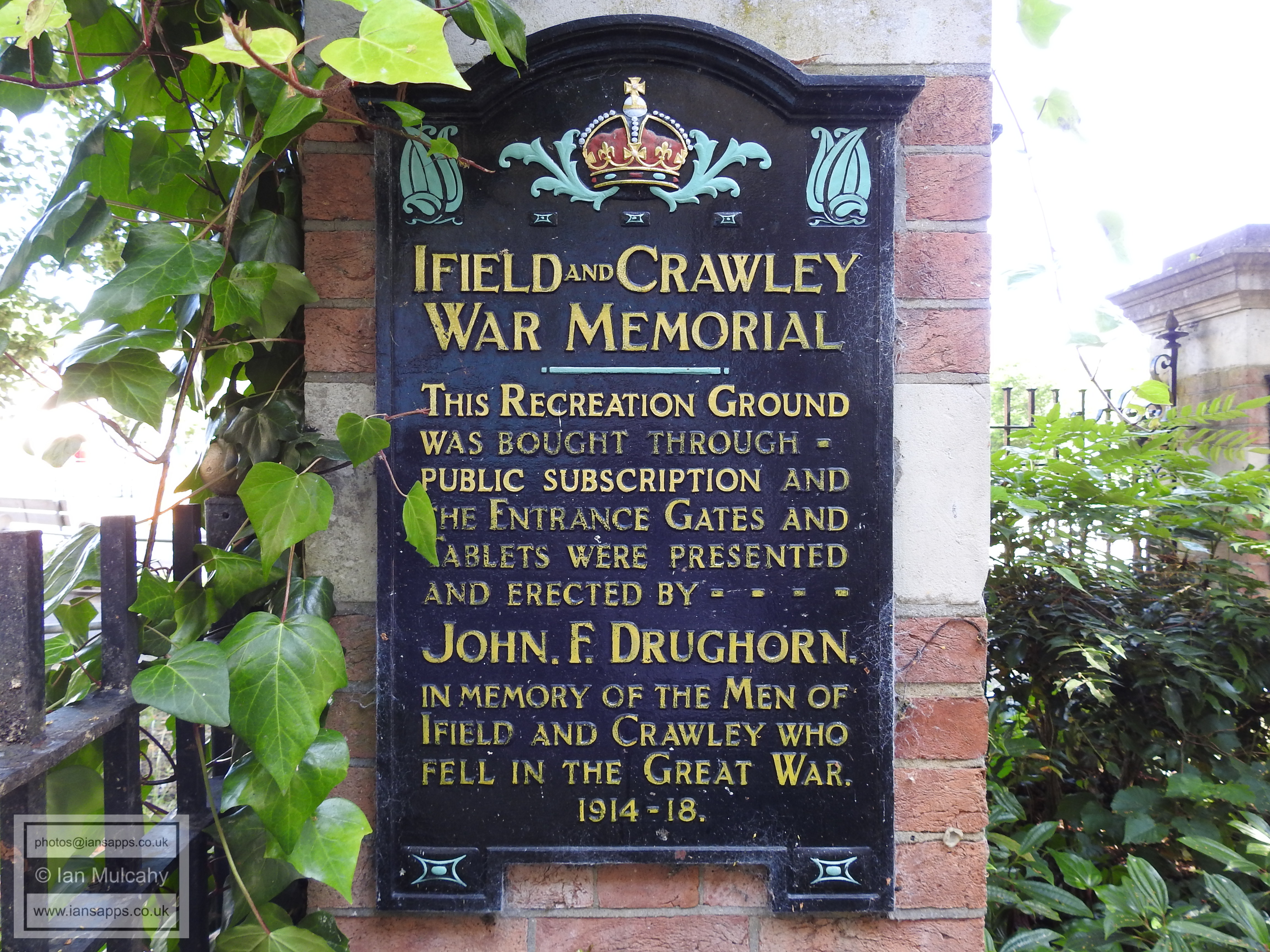
It wasn’t only the ancient buildings of the town that were dismissed as being unimportant by the Corporation, who also decided that the Memorial Recreation Ground (now known as the Memorial Gardens and, at the time, home to Crawley Cricket Club) was there for the taking. They argued that it was just ‘where the swings and roundabout are’, seemingly ignoring the fact that the grounds were owned by the people of the town having been purchased by public subscription in 1921 as a memorial to those from the town who had lost their lives during the Great War. The Corporation officials also somehow managed to miss the plaques on the pillars of the southern entrance to the grounds which listed the war dead of the town from both World Wars. The original Great War plaques were ‘presented and erected by’ Sir John Drughorn, Lord of the Manor of Ifield, presumably when the grounds were opened. The extra plaques, with the casualties of World War Two listed, were unveiled on 27 March 1949 and all are in-situ today, though what we see now are replicas after some of the originals were stolen in the 1990s; the surviving originals are in the custody of Crawley Museum. As everyone will be aware, on this (rare) occasion the weight of public opinion counted for something and, although some of the grounds were lost to College Road, they were mostly retained by the new town planners and are now held in trust.
When the new arrivals started to settle in the town, it didn’t really bother Andrew that much and it certainly didn’t affect his childhood. Stewart adds that his and Andrew’s thoughts of the new town were less likely to be an echo of their parents feelings on the matter because, although Andrew & Eric in particular had memories of the old town, they essentially grew up with the new town and the benefits that it provided, whereas their parents didn’t and just saw their community being destroyed, which made them bitter and created divisions between the old and new residents of Crawley. Stewart doesn’t recall his father, who was brought up in Three Bridges, having much to say about it at all, but Andrew adds that his mum didn’t like the way they ruined things without really caring or giving thought to those for whom Crawley had been home for decades.
Andrew didn’t immediately make friends with the newcomers because he already had his friend group and West Street was fairly contained and not close to any of the early development. Things were different for Stewart as his birth coincided with the early development work so by the time he started school, at West Green Primary, his peers and friends were mostly new towners and there was generally no animosity between the new and the old. Andrew felt that there was a different culture between the Crawley children and the arrivals from London, but then that’s not too surprising as the locals had grown up in a small country town surrounded by countryside, whereas the newcomers had spent their early years in a crowded city surrounded by death and destruction.
Despite being a year old than Andrew, Eric did make friends with new town children quite quickly as he was closer to the early development and attended St Peter’s Church in West Green, as did many of the new arrivals. Eric later became a server at the church and for that role he needed to wear a black cassock. Being tall and fairly thin, he had a search on his hands to find a suitable one and when he finally laid his hands on one that fitted he looked inside and found a name tag; David Lock again. From the totem pole at Cubs to the cassock in Church, Eric certainly seemed to be following in the footsteps of the elder brother of his future friends, who he didn’t know properly until they met at the Barn Theatre in later years.
One of the pride and joys of the Corporation was the Starlight Ballroom in the High Street which stood on the site of the failed Morrisons Supermarket and between 1965 & 1971 hosted the likes of (in chronological order) Small Faces, The Hollies, The Moody Blues, The Who, Pink Floyd, Jimi Hendrix, Ike & Tina Turner, Black Sabbath, Uriah Heep, Status Quo, Hawkwind and Genesis. Despite this impressive roster of acts, Eric tells how the venue flopped as it generally didn’t get used much. He puts this down to the fact that people had moved from cramped accommodation in London to spacious new houses with gardens and, as a result, they’d furnished their new homes on hire purchase which left them with a weekly financial commitment. Many of the new towners also had young children, so simply didn’t have the time or money to go out too often. Stewart adds that the nature of Crawley’s design also played its part as the neighbourhoods were relatively self-contained so the residents generally stayed within their own neighbourhood, where they had a shopping parade, a pub, a community centre and their children’s school all within short walking distance. To go to The Starlight, you needed to go into town and it was far easier to just nip down to the local pub for a pint or two and socialise with your neighbours.
Eric recounts how each of the local shopping parades would have a butcher, bakers, newsagent, greengrocers, pharmacy, hardware store & pub, with a church and community centre nearby; it had everything you needed in a central location within each neighbourhood. But these shops didn’t pull in vast amounts of money - Eric says that if you spent a fiver on a shopping trip then you had spent an awful lot of money so, with customers spending a fiver or less, when the rents were hiked the specialist independent shopkeepers simply couldn’t afford to pay so they were forced to close down, being replaced by betting shops and takeaways. As Stewart says, the advent of larger supermarkets also accelerated the decline as residents naturally gravitated towards cheaper produce which they could buy in a single store. Andrew goes as far to say that supermarkets “are a lousy thing really because they just buggered up the whole community… and all the decent local shops were just priced out of business”.
Eric and his wife used to support the local butcher at West Green Parade, even after moving to Furnace Green, but the local shops closing for lunch was an added inconvenience for ever more time poor customers which contributed to their downfall, so his wife started shopping in Tesco's and she wasn’t going to buy everything BUT their meat in the supermarket and then drive over to West Green just for that. Andrew laments that it’s just the way everything changes, and always has done, but looking back he draws the conclusion that “we are all a damned sight better off than we were, that’s for sure. It’s all foreign holidays and the rest of it now, but we just couldn’t afford that”.
Wise words, that some would do well to read so as to understand how fortunate they are today.
A video of Eric talking about his memories of Ifield Barn theatre can be viewed at https://www.youtube.com/watch?v=KUQMRVJBpLA
Sources:
Text & photographs (unless stated otherwise) © Ian Mulcahy. Contact photos@iansapps.co.uk or visit my 'Use of my photographs' page for licensing queries (ground level photographs only). |